 Welcome to the United Nations

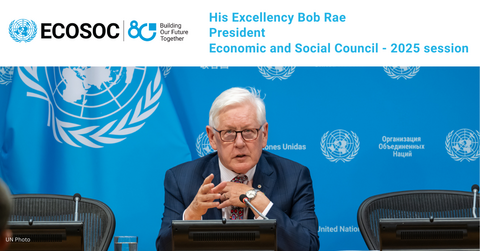
By H.E. Mr. Bob Rae, President of the United Nations Economic and Social Council - 2025 session
Eighty years is a milestone. Yet in the long arc of human history, it is only a small window.In 1945, determined to chart a new path after two devastating wars, Member States created the United Nations. As part of its Charter, they also established the Economic and Social Council (ECOSOC), designed to support a universal vision of peace, economic prosperity and social development.
Despite its relative youth, ECOSOC has guided the international community through post-war reconstruction efforts, the Millenium Development Goals, and now the pursuit of the 2030 Agenda for Sustainable Development. It has always adapted alongside a changing world.
Today, the ECOSOC system – including its subsidiary bodies and the High-Level Political Forum – exists as a place where the world’s aspirations are shaped and advanced. It is where the Sustainable Development Goals become more than metrics; they reflect our shared humanity and collective responsibility.
ECOSOC brings together not only governments, but also civil society, youth, Indigenous Peoples, the private sector, and other stakeholders. This diversity of lived experiences is essential for effective and legitimate multilateralism.
Reflecting on my Presidency of the Council during the 2024–2025 session, I saw firsthand ECOSOC’s transformative potential when it is inclusive, responsive, and forward-looking. It can drive coherence across the UN system and amplify voices too often left unheard in global decision-making.
We live in a time when the UN is being called upon to reform, to deliver, and to prove its worth. In this landscape, ECOSOC must once again evolve. It must sharpen its coordination of the UN Development System, align its cycles and structures to better support Member States, and reaffirm that stakeholder engagement is not optional – it is essential to achieving sustainable development.
The Charter we celebrate this year is not perfect. But it gave us the tools to build a better world. ECOSOC is one of those tools: for listening, for learning, and for leading.
So let us mark ECOSOC’s 80th anniversary not only with retrospection, but with recommitment. Let us honour its legacy by investing in its future. And let us never forget that our task is not abstract; it is profoundly human.
It is about the child who deserves a future free of poverty, the community that seeks resilience in the face of climate change, and the technologist harnessing AI for good.
It is about ensuring that our aspirations are realized.